Architecting the Enterprise for Agentic AI: Platforms and Orchestration Foundations
By 2026, the defining challenge for enterprise technology leaders is no longer whether artificial intelligence can be deployed at scale, but whether it can be architected to operate autonomously, reliably, and safely across the organization. The shift from predictive and generative AI toward agentic systems represents a structural change in how software is designed and governed. Agentic AI systems do not merely respond to prompts or execute predefined workflows; they perceive context, reason over goals, coordinate actions across tools and systems, and adapt their behavior over time. For CIOs and CTOs, this evolution demands a rethinking of enterprise architecture foundations that were built for static applications and narrow AI use cases.
Traditional AI architectures, optimized for batch prediction or isolated model inference, struggle under the demands of agentic systems. These systems introduce continuous decision loops, multi-step reasoning, dynamic tool use, and interaction with real-time data sources. They also challenge long-standing assumptions about control, determinism, and system boundaries. As enterprises move from experimentation toward embedded, mission-critical agentic capabilities, the absence of a coherent architectural strategy becomes a source of operational risk rather than technical debt. This article outlines a modern reference architecture for agentic AI in the enterprise, with particular emphasis on orchestration layers, integration patterns, and platform-level decisions that will define technology strategy over the next decade.
The limitations of traditional AI architectures become apparent when agentic systems are deployed beyond narrow pilots. Conventional machine learning pipelines were designed around discrete phases of training, validation, and inference, often separated by organizational silos. Even more recent generative AI deployments typically wrap large language models with lightweight application logic, relying on prompt engineering and manual oversight to achieve acceptable outcomes. While effective for isolated tasks, these approaches do not scale when AI systems are expected to manage complex processes, coordinate across domains, or operate continuously with minimal human intervention.
One fundamental issue is that traditional architectures assume a clear boundary between decision-making and execution. Models produce outputs, and downstream systems act on them. Agentic AI collapses this distinction. Agents must decide which tools to invoke, which data to retrieve, how to sequence actions, and when to escalate or defer decisions. This creates feedback loops that traditional architectures were never designed to manage. Without explicit orchestration and state management, enterprises quickly encounter brittle behavior, opaque failure modes, and uncontrolled system interactions.
Another constraint lies in data and context handling. Legacy AI systems rely heavily on static datasets or narrowly scoped feature stores. Agentic systems, by contrast, require persistent memory, contextual awareness across sessions, and access to both structured and unstructured enterprise knowledge. Attempting to bolt these capabilities onto existing architectures often results in fragmented solutions that are difficult to govern and nearly impossible to audit. As agentic deployments grow, the absence of a unified architectural foundation becomes a barrier to scale rather than a temporary inconvenience.
A modern agentic architecture begins with a clear separation of concerns between intelligence, coordination, and execution. At the core are agent runtimes that host reasoning models, whether large language models, domain-specific models, or hybrid approaches. These runtimes are responsible for interpreting goals, maintaining internal state, and generating action plans. However, they should not be tightly coupled to enterprise systems or business logic. Instead, they operate within an orchestration framework that governs how agents interact with tools, data sources, and each other.
The orchestration layer is the defining component of enterprise-grade agentic architectures. It serves as the control plane that manages task decomposition, agent collaboration, execution sequencing, and exception handling. Unlike traditional workflow engines, orchestration for agentic AI must accommodate uncertainty and non-determinism. Plans may evolve as new information becomes available, and execution paths cannot always be predefined. The orchestration layer therefore needs to balance flexibility with guardrails, enabling adaptive behavior while enforcing enterprise policies, compliance requirements, and resource constraints.
Closely related to orchestration is the concept of memory. In agentic systems, memory is not merely a cache or a database; it is a first-class architectural component that enables continuity and learning. Short-term memory supports in-session reasoning, while long-term memory allows agents to retain knowledge across interactions, refine strategies, and personalize behavior. Enterprise architectures must distinguish between ephemeral context, durable operational records, and curated knowledge assets, ensuring that each is stored, accessed, and governed appropriately. Without this distinction, memory quickly becomes a liability, exposing organizations to data leakage, compliance risks, and uncontrolled model behavior.
Tool integration represents another critical pillar of agentic architectures. Agents derive much of their value from the ability to act within enterprise environments, invoking APIs, querying databases, triggering workflows, and interacting with external services. Rather than granting agents direct access to systems, best practice architectures introduce a tool abstraction layer. This layer standardizes how tools are described, discovered, and invoked, and provides a control point for authentication, authorization, and monitoring. By mediating tool access, enterprises can enable powerful agent capabilities without compromising security or stability.
Data architecture also takes on new importance in the agentic paradigm. Real-time data pipelines, event streams, and knowledge graphs become essential sources of situational awareness for agents. Static data lakes and batch ETL processes are insufficient when agents must respond to changing conditions or coordinate actions across systems. CIOs must therefore align agentic initiatives with broader data modernization efforts, ensuring that data is timely, trustworthy, and semantically rich. The convergence of agentic AI and modern data platforms is not incidental; it is a prerequisite for sustained value creation.
Integrating agentic architectures with legacy systems remains one of the most challenging aspects of enterprise adoption. Most organizations operate complex landscapes of ERP, CRM, mainframe, and custom applications that were never designed for autonomous interaction. A naive approach, granting agents direct access to legacy systems, often leads to fragile integrations and unacceptable risk. Instead, successful architectures interpose integration layers that expose legacy capabilities through well-defined services and events. This not only protects core systems but also creates a consistent interface for both human users and AI agents.
Event-driven architectures are particularly well suited to bridging agentic systems and legacy environments. By emitting and consuming events, agents can react to business state changes without tightly coupling to underlying applications. This decoupling enables incremental adoption, allowing organizations to introduce agentic capabilities alongside existing processes rather than attempting disruptive rewrites. Over time, as legacy systems are modernized or replaced, the same integration patterns can be reused, preserving architectural coherence.
As enterprises evaluate how to implement these architectures, build-versus-platform decisions loom large. The rapid emergence of agentic AI platforms, offering pre-built orchestration, memory, and tool management capabilities, presents both an opportunity and a dilemma. Building bespoke architectures provides maximum control and alignment with enterprise standards, but it requires significant investment and specialized expertise. Platforms promise accelerated time to value and reduced complexity, but they introduce dependencies and potential constraints on customization and governance.
For most enterprises, the optimal approach lies between these extremes. Core architectural principles, integration standards, and governance models should be defined internally, reflecting the organization’s risk appetite and strategic priorities. Within this framework, platforms can be selectively adopted to provide commoditized capabilities such as agent runtimes, orchestration engines, or monitoring tools. The key is to avoid treating platform selection as a substitute for architectural thinking. Without a clear reference architecture, platform adoption risks becoming another source of fragmentation rather than a catalyst for scale.
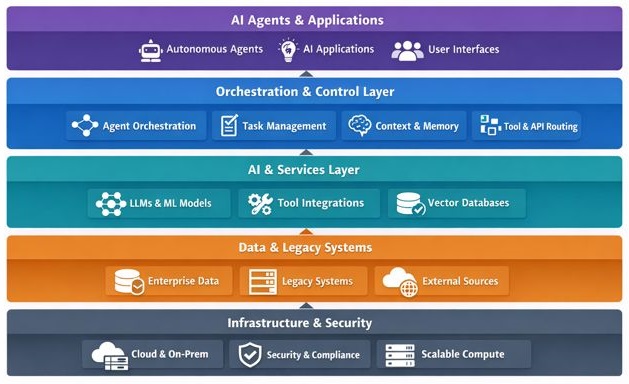
A practical reference architecture for agentic AI can be visualized as a layered system. At the foundation sit enterprise data platforms, integration services, and security infrastructure. Above this foundation is the orchestration and control layer, responsible for coordinating agents, managing memory, and enforcing policies. Agent runtimes and models operate above orchestration, encapsulating reasoning and decision-making logic. At the top are business applications and user interfaces, where agentic capabilities are embedded into workflows and experiences. While the specific technologies will vary, this conceptual structure provides a stable blueprint for decision-making.
Such a reference architecture also clarifies accountability. CIOs and CTOs can assign ownership for each layer, align investment with strategic importance, and establish metrics for reliability, performance, and value. It enables more constructive conversations with vendors, shifting the focus from model benchmarks to architectural fit and operational resilience. Most importantly, it positions agentic AI not as an experimental overlay but as an integral component of enterprise systems.
As agentic AI moves into the core of enterprise operations, architecture becomes a strategic lever rather than a technical afterthought. Organizations that invest early in orchestration, integration, and governance foundations will be able to scale agentic capabilities with confidence. Those that rely on ad hoc solutions and isolated platforms will find themselves constrained by complexity and risk. For technology leaders, the imperative is clear: architect not just for intelligence, but for autonomy, coordination, and control.
The transition to agentic AI is not a single project but a multi-year evolution. By establishing a modern reference architecture today, CIOs and CTOs can ensure that this evolution strengthens, rather than destabilizes, the enterprise. In doing so, they lay the groundwork for a future in which AI is not merely a tool, but a trusted participant in the fabric of organizational decision-making.