Four Pillars of Gen AI Technology
When Morgan Stanley launched AI @ Morgan Stanley Debrief, it wasn’t simply adding another productivity tool to its wealth management business. The system, powered by OpenAI technology, automatically transcribes and summarizes client meetings, drafts follow-up emails for advisors to review, and integrates notes directly into Salesforce. What began as an efficiency initiative has become a transformative capability, allowing advisors to spend more time building client relationships and less time on administrative work. Early feedback indicated improved advisor productivity and stronger client engagement. This case illustrates what happens when autonomous agents powered by generative AI are introduced into the heart of a value chain: the creation of new business capacity through reasoning, communication, tool integration, and autonomous execution. These four pillars define the essence of generative AI as the primary enabler of the autonomous enterprise.
Generative AI differs from prior waves of enterprise automation because it operates not as a rigid system of rules, but as an adaptive technology capable of multimodal reasoning, interaction, and decision-making. Central to this technological revolution is the autonomous agent: a system that can interpret objectives, interact through natural communication, access and act on enterprise data, and orchestrate workflows across complex environments. Unlike earlier automation scripts or RPA bots, these agents are not brittle. They can adapt to context, apply generalizable reasoning skills, and collaborate with humans or other agents to achieve higher-order business outcomes. The autonomous enterprise emerges when such agents are embedded across value chains, continuously creating, transforming, and capturing value with minimal human intervention.
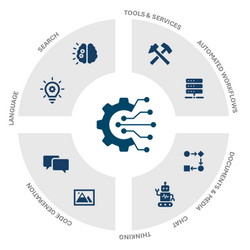
Pillar 1: Reasoning
The four pillars of generative AI technology provide the conceptual framework for understanding how this transformation occurs. The first pillar is reasoning. This is the ability of generative AI to apply chain-of-thought processes that break down complex problems into solvable steps. In practice, reasoning enables agents to support executives in strategic scenario planning by analyzing thousands of potential market variables and simulating outcomes. It also allows operations teams to optimize supply chain networks, balancing cost, resilience, and sustainability goals simultaneously. Where traditional analytics provide dashboards, reasoning agents provide insight and recommendation, moving from passive reporting to active problem-solving.
Pillar 2: Communication
The second pillar is communication. Unlike conventional enterprise systems that require structured queries or technical expertise, generative AI communicates naturally through text, voice, images, and video. A retail bank, for example, can deploy an AI agent that engages customers across channels, responding to loan inquiries through voice interactions while simultaneously generating personalized repayment schedules and visual simulations of different scenarios. In another case, a manufacturing company can use communication capabilities to train its global workforce through interactive multimodal modules, dynamically adjusting the training material to cultural and linguistic contexts. Communication is not simply a user interface. It is the bridge that brings AI’s reasoning into human workflows in an accessible, persuasive, and adaptive manner.
Pillar 3: Tools
The third pillar is tools. Reasoning and communication alone are insufficient if the agent cannot act within the enterprise environment. Tool integration enables generative AI systems to connect with internal and external services, retrieve up-to-date information, and execute actions. One compelling example is retrieval augmented generation in pharmaceutical R&D, where agents continuously pull data from research databases, clinical trial results, and regulatory updates to accelerate drug development decisions. Another example is in corporate finance, where an agent can integrate with ERP systems, extract financial data, perform reconciliations, and even initiate corrective transactions. Tools transform generative AI from a conversational assistant into an active operator embedded in the enterprise value chain.
Pillar 4: Autonomy
The fourth pillar is autonomy. This is where the promise of the autonomous enterprise is most visible. Autonomy enables agents not just to execute individual tasks, but to plan and carry out entire workflows that span multiple systems, stakeholders, and objectives. In logistics, an autonomous agent can receive a high-level objective, e.g. reduce last-mile delivery costs by five percent, and then coordinate with route optimization services, fleet management systems, and customer communications to achieve the target. In corporate HR, agents can autonomously manage recruiting pipelines, from posting job descriptions to screening applicants, scheduling interviews, and drafting offer letters, all while ensuring compliance with employment regulations. Autonomy is the synthesis of the other pillars into a self-directed execution engine.
In practice, autonomous agents do not operate within a single pillar at a time. They fluidly move between them, shifting modes as business objectives demand. An agent may begin with a reasoning task, analyzing sales performance data; use communication to present insights to a regional manager; employ tools to retrieve external market data; then exercise autonomy to recommend and implement pricing adjustments. Memory extends these capabilities, allowing agents to retain context over time, learn from past interactions, and adapt strategies to evolving circumstances. The result is a system that feels less like software and more like a continuously learning business partner.
At scale, these agents rarely act alone. Multi-agent systems emerge as networks of specialized agents that collaborate, coordinate, and divide labor to handle complex value streams. Some agents may specialize in customer interactions, while others focus on regulatory compliance, supply chain optimization, or financial planning. They may operate under central coordination when objectives are highly structured, or execute asynchronously in response to market events and enterprise triggers. The dynamic interplay of multi-agent systems mirrors the structure of human organizations but with vastly greater speed, consistency, and scalability.
The impact of generative AI and autonomous agents on the modern enterprise value chain depends on the level of organizational maturity. At the early stages, companies deploy agents for narrow automation, such as scheduling meetings, answering customer inquiries, or retrieving data from systems. These use cases deliver efficiency gains but remain adjunct to core operations. As maturity advances, agents begin managing discrete processes end-to-end, such as order fulfillment or regulatory reporting. At the highest level, mature autonomous enterprises orchestrate entire value streams with minimal human oversight. In this vision, agents can own profit-and-loss accountability, manage supplier ecosystems, design customer experiences, and drive continuous innovation. The transition resembles the industrial revolutions of the past: gradual adoption followed by structural redefinition of business itself.
The implications of this technology to the business are profound. Generative AI anchored in the four pillars is not a passing technology wave; it is the foundation for the autonomous enterprise. CEOs, CIOs, and CTOs must recognize that the shift is not about incremental productivity but about reimagining how value is created and delivered. Planning for this future requires investment in enterprise architectures that enable agent autonomy, governance frameworks that ensure ethical and compliant operation, and organizational strategies that balance human expertise with AI-driven execution. The competitive frontier will increasingly be defined not by who has access to AI, but by who can integrate agents deeply into their value chains, achieving higher levels of autonomy and strategic agility. The enterprises that lead in this transformation will not simply operate more efficiently; they will redefine the boundaries of what a business can be.
References
Morgan Stanley Wealth Management. (2024, June 26). AI @ Morgan Stanley Debrief acts as notetaker, summarizer and first-draft communication composer for client meetings, greatly enhancing efficiency and enabling scale for Advisors and their practices [Press release]. Morgan Stanley.